IMProving Railway sEcurity through awareneSS and training
Improving railway security through awareness and training

About
IMPRESS aims at improving the protection of stations and trains by developing security training and awareness programmes for all stakeholders in rail stations and on trains.
Aim of the project
The scope of the training includes security culture in general, with a wide range of significant threats for several European rail operators, and CBRNe (Chemical, Biological, Radiological, Nuclear and explosive) threats specifically. The project focuses on the immediate responders from the railway environment — rail staff at stations and onboard trains, security staff, station shops, cleaning staff and other service providers.
Facts & Figures
- Project Acronym
- IMPRESS
- Call ID and Topic
- ISF-2022-TF1-AG-PROTECT
- Grant Agreement No
- 101100521
- EU Contribution
- € 952 546.63
- Starting date
- 1 June 2023
- Duration
- 24 months
- Coordinator
- UIC Security Department
Main objectives
Main objectives
- Improving the protection of trains and stations against terrorist-related threats.
- Enhancing public-private cooperation and good practices in trains and stations.
- Raising security awareness of the stakeholders working in stations and trains.
- Developing awareness and guidance materials for CBRNe threat.
Expected results
- Assessment of training needs and identification of target groups across Europe.
- Awareness and training modules designed with end-users and developed by security and training experts.
- Modules tested and evaluated by consortium rail companies, with feedback integrated into final versions.
- Results disseminated through the UIC Rail Security Hub.
Organisation of the Work
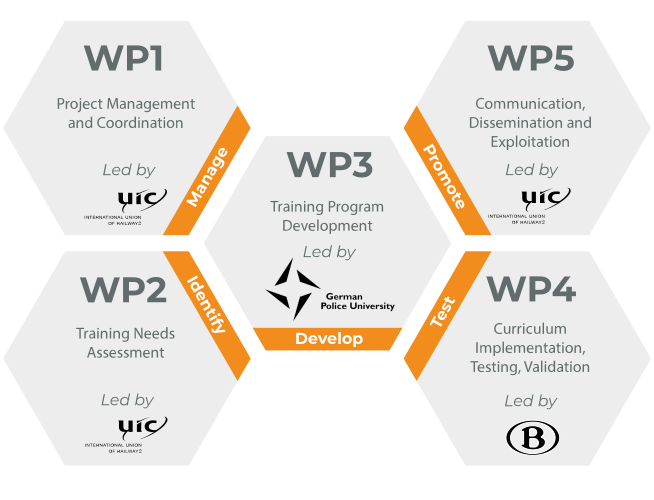
The core work is divided in three technical work phases represented by three technical work packages.
- Assessment of training needs through a review of past project results and a questionnaire to identify target groups and their specific training and security awareness needs across Europe and beyond.
- Design of awareness and training modules, validated with end-users in two workshops, then developed by experts in both training and security.
- Testing and evaluation of the modules by rail companies in the consortium, with feedback taken into account to adapt and improve the training modules.
- Dissemination through the UIC Rail Security Hub, an online platform where users can retrieve information on security solutions and share operational experiences.
Consortium
Coordinated by the UIC Security Division, the project is implemented in partnership with the security services of several major European railway companies and one police university.



Advisory Board
An Advisory Board, composed of key stakeholders with relevant expertise and knowledge about the project topics and activities, supports the consortium throughout the project from a strategic point of view, providing inputs and feedback on project outcomes. International organisations: RAILPOL, COLPOFER, UITP. Rail sector: DB, Eurostar, Euskotren, EVR, Infrabel, Koleje Śląskie, RPF of Indian Railways, SNCF, Transport Canada, RSSB, Wiener Linien. Authorities: German Federal Police, French first responders, Polizei Münster, Public Transport Administration Region Stockholm, PTBN. If you wish to apply to join the IMPRESS Advisory Board, please contact us.
Get involved
Contact the project team to express your interest in joining the advisory board.
Where our partners are
IMPRESS consortium partners across Europe.
News & Events
- Successful joint meeting of the UIC Security Platform New Technologies Working Group and BEHOLDER EU-project25 March 2026
- UIC Security: Progress and Cooperation in 202516 January 2026
- UIC Security Platform holds its Steering Committee Meeting at UIC Headquarters and online04 July 2025
- UIC showcases project research results at the invitation of the European Commission03 July 2025
- European IMPRESS project: Final conference held on 14 May in Paris21 May 2025
Key Public Results
IMPRESS public results include an awareness video, multilingual digital awareness campaigns, and a serious game to spark discussions about suspicious behaviours in the rail environment.
Awareness video
The video focuses on detecting suspicious behaviours and how to act in case of an attack. Subtitled versions are available in French, Dutch, Polish, German and Italian on YouTube.
Deliverables
- D1.1Quality assurance plan(upcoming)
- D1.2Mid-term report progress(upcoming)
- D1.3Output and results indicators(upcoming)
- D2.1Security training needs in rail environment(upcoming)
- D3.1Report on the design of the global training programme/curriculum(upcoming)
- D3.2Training modules – First version(upcoming)
- D3.3Training modules – Revised version(upcoming)
- D4.1Report on the training sessions(upcoming)
- D4.2Report on the evaluation(upcoming)
- D5.1IMPRESS public website with a restricted area(upcoming)
- D5.2Project brochure
- D5.3Dissemination and exploitation plan – First version(upcoming)
- D5.4Dissemination and exploitation plan – Final version(upcoming)